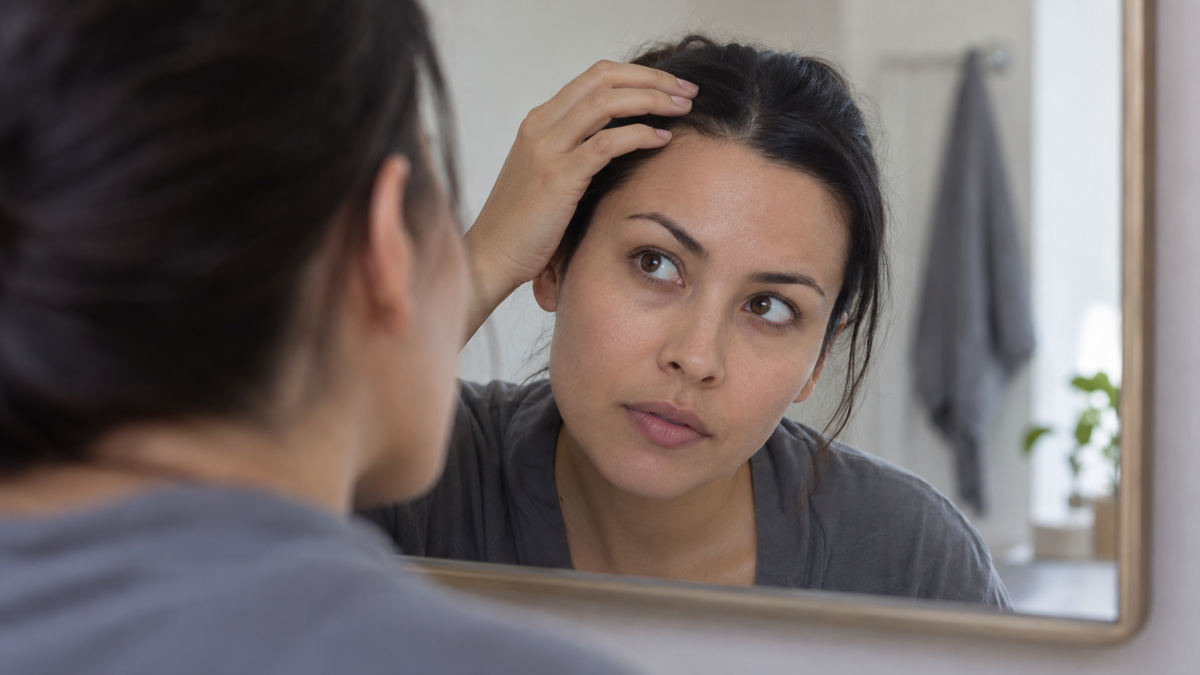
A rash of tiny, near-identical bumps shows up on the forehead or hairline. It doesn't quite look like your usual breakouts, but it's close enough that you reach for the acne routine — a salicylic acid wash, a benzoyl peroxide spot treatment, maybe a course of doxycycline from the GP. Six weeks later it's the same. Sometimes worse.
There's a persistent idea that "a bump is a bump" and any acne treatment will eventually work if you're patient. It's almost true — except when the bump isn't acne at all.
What people call "fungal acne" isn't acne
The clinical name is Malassezia folliculitis (previously known as pityrosporum folliculitis). It's an overgrowth of Malassezia yeast — a fungus that already lives on almost everyone's skin — inside the hair follicle. A 2025 review in the Journal of Fungi describes the presentation as "mildly pruritic, 1–2 mm, monomorphic follicular, erythematous or skin-colored papules and pustules" across the forehead, hairline, chest, back and shoulders. The word doing the heavy lifting there is monomorphic: the bumps look basically identical to each other, all roughly the same size, all at the same stage. Real acne is polymorphic — a whitehead here, a cyst there, a blackhead over the nose, a scar healing on the chin.
The same review notes that in one series, 75% of Malassezia folliculitis patients had been previously treated for acne vulgaris unsuccessfully, often after months of antibiotics. A 2021 case report in Cureus describes a 24-year-old woman who cycled through topical clindamycin, oral antibiotics, and even isotretinoin over three months before a skin scraping under KOH revealed fungal hyphae and spores. Two weeks of antifungal treatment cleared "nearly 90% of her skin lesions."
That's the tell. Standard acne treatments don't do much for Malassezia — and courses of oral antibiotics can actively make it worse by disturbing the bacterial neighbours that normally keep the yeast in check.
How to tell it apart from ordinary acne
You can't diagnose yourself with certainty; a KOH scraping under a microscope is the definitive test and takes a doctor a few minutes. But there are patterns worth noticing before you book that visit.
| Feature | Malassezia folliculitis | Acne vulgaris |
|---|---|---|
| Bump shape | Uniform, 1–2 mm, all similar | Varied — whiteheads, blackheads, cysts |
| Comedones (blackheads/whiteheads) | Usually absent | Central feature |
| Itch | Often, though not always | Rare |
| Location | Forehead, hairline, chest, upper back, shoulders | T-zone, cheeks, jaw |
| Triggers | Sweat, humidity, occlusive fabrics, recent antibiotics | Hormones, friction, comedogenic products |
| Response to acne antibiotics | None, or worsens | Improves over weeks |
The "no comedones" point is the most useful one at home. If you look closely and can't find a single blackhead or whitehead in a whole field of otherwise-uniform bumps, that's suspicious.
Why Singapore's climate makes it more common
Malassezia loves warmth, sweat, and occluded skin. The 2025 review lists "hot, humid environments where sweating occurs" as a major risk factor, and cites data where 83% of patients in one study reported working in a warm environment and 71% named sweating as an aggravating factor. That describes a lot of daily life here — a 30°C commute, a gym session, a motorbike helmet, a mask, a cap you don't take off.
None of that causes the yeast; the yeast is already there. Humidity just lets it multiply faster than your skin's usual balance can handle.
Why some skincare "feeds" the yeast
Malassezia species can't make their own fatty acids. They have to scavenge them from the environment — either from your own sebum, or from what you put on top of it. A 2020 study in the Journal of Investigative Dermatology confirmed the fungus depends on external long-chain fatty acids (from about C12 upward in the acids they tested) to grow at all, and identified specific enzymes it uses to activate those lipids.
That's the biological reason certain skincare ingredients — many plant oils rich in oleic acid, some fatty alcohols, some esters, fermented yeast extracts — tend to make fungal acne flare while doing nothing to bacterial acne. It isn't magic and it isn't allergy; it's that the yeast eats the ingredient.
You don't need to memorise a blacklist. If you're pretty sure you have Malassezia and your skincare feels like it's making things worse, simplifying is a fair first move: a gentle non-oily cleanser, a humectant hydrator (glycerin, hyaluronic acid, panthenol are all sugar- or alcohol-based and don't feed Malassezia), a mineral or non-oily sunscreen. Then see a dermatologist for the actual diagnosis before rebuilding.
What actually clears it
The evidence is straightforward: antifungals work; antibiotics don't. The 2025 review reports 80% clinical recovery with topical ketoconazole at four weeks in one comparative study, and 84.6% mycological clearance with oral itraconazole at five weeks in another. In real-world practice in Singapore, a dermatologist will often start with a topical antifungal (ketoconazole cream, or the shampoo used as a short-contact face wash a few times a week) and escalate to oral itraconazole or fluconazole for stubborn cases.
Two honest caveats. First, relapse is common — the yeast is a normal skin resident, and when the humidity and sweat come back so does the overgrowth. Second, you can have both fungal folliculitis and ordinary acne at the same time, which is why guesswork can only get you so far.
The routine adjustment worth making now
While you're waiting to see a doctor, three low-risk changes are worth making:
- Shower and change out of sweaty clothes promptly after workouts, commutes, or long days in a mask or helmet. The 71%-of-patients-cite-sweat figure earns its keep here.
- Wash pillowcases and hats more often. Occlusion plus sebum plus warmth is the yeast's ideal environment.
- Stop escalating acne actives. If salicylic acid, benzoyl peroxide and retinoids haven't worked in six to eight weeks on a field of uniform bumps, doubling down isn't the answer. Simplify and get a diagnosis.
None of that is a cure. It just stops you from spending another three months treating the wrong condition.


