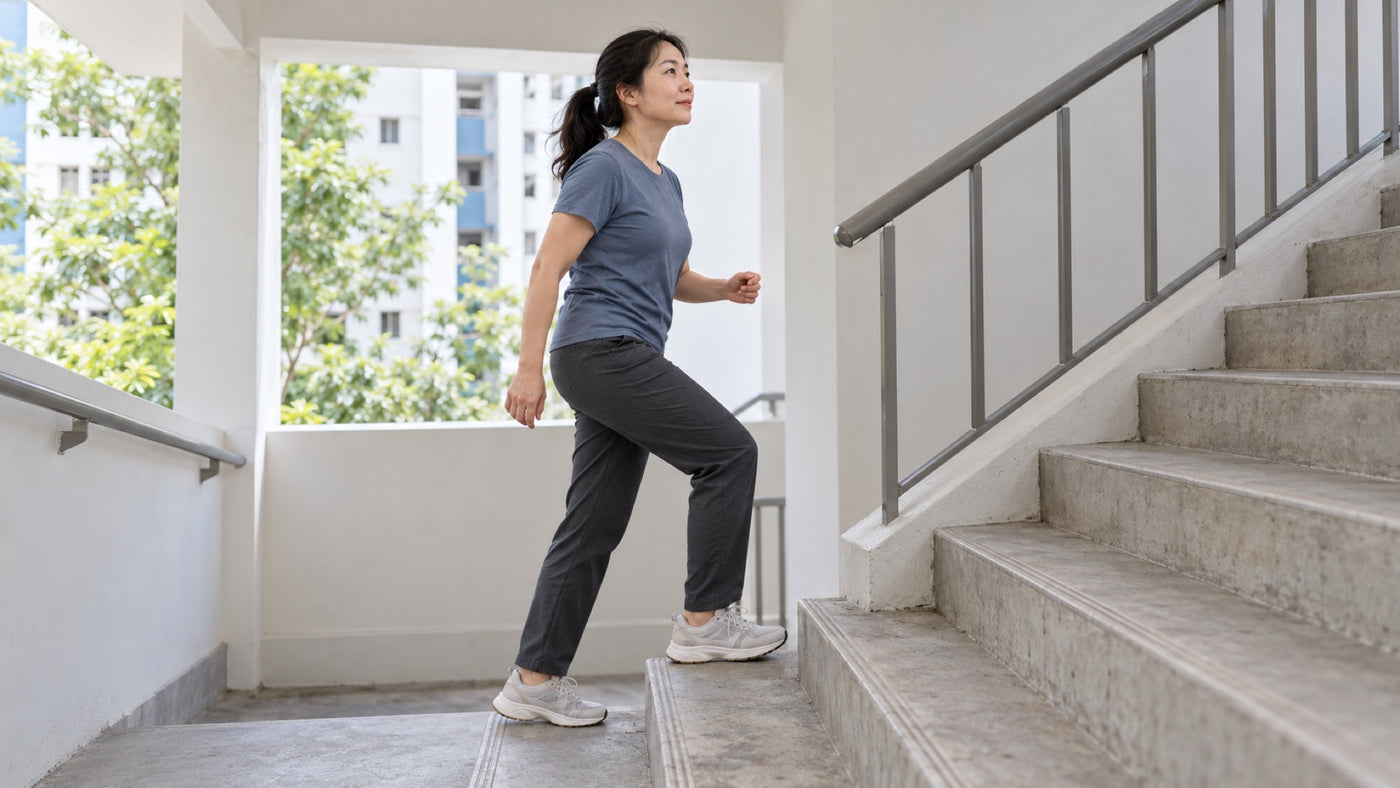
Most fitness advice still assumes you'll block out thirty or forty minutes, change clothes and drive to something. For a lot of people in Singapore, that's the reason they end most weeks having done almost nothing — not because they don't care, but because the shape of a "workout" never fits the day.
The research that's been quietly building for the last five years takes a different angle. It asks a smaller question: what happens when you count the one minute you spent running up the HDB stairwell with your groceries, or the ninety seconds you spent power-walking to catch the lift before the doors closed? The answer, so far, is that those seconds appear to count for more than almost anyone expected.
What counts as an "exercise snack"
The term covers two overlapping ideas. In the lab, researchers like McMaster University's Martin Gibala have tested very short, hard bouts — classically about twenty seconds of vigorous stair-climbing, done three times a day with an hour or more between — as a feasible alternative to one longer session. In free-living research, Sydney epidemiologist Emmanuel Stamatakis and colleagues coined the slightly broader label VILPA — vigorous intermittent lifestyle physical activity — for the same shape of movement when it happens incidentally through the day: short bursts, roughly one to two minutes, that get you breathing hard enough you couldn't comfortably hold a conversation.
The common thread is intensity, not duration. A gentle amble to the MRT doesn't count. A brisk, uphill, "I'm going to miss the bus" walk, carried for a minute, does.
What the Nature Medicine study actually found
In December 2022, Stamatakis and colleagues published a wearable-device study in Nature Medicine that tracked 25,241 UK Biobank participants (mean age 61.8) who reported doing no leisure-time exercise and no more than one recreational walk per week. Everyone wore a wrist accelerometer for a week. The researchers then followed the group for an average of 6.9 years, during which 852 people died.
The pattern was striking:
| VILPA dose (per day) | All-cause mortality risk | CVD mortality risk |
|---|---|---|
| None | reference | reference |
| ~3 bouts of 1–2 min (sample median) | 38–40% lower | 48–49% lower |
| ~4.4 min total (sample median) | 26–30% lower | 32–34% lower |
Those are large numbers. They came from a group that, on paper, was doing no exercise at all. The authors ran the same analysis in 62,344 exercisers and found a similar dose-response for vigorous activity in general.
A few caveats are worth stating plainly, because they're exactly where this kind of result tends to get oversold:
- This is an observational association, not a trial. People who sprint up stairs may be healthier for other reasons — less back pain, less undiagnosed illness — and the authors say reverse causation can't be entirely ruled out, though their sensitivity analyses held up.
- The UK Biobank sample isn't representative of the general population (the response rate was about 5.5%).
- Wrist accelerometers can miss some vigorous activity, which the authors argue would, if anything, make the real effect larger rather than smaller.
So: don't take "48% lower" to the bank. Do take "very short, hard bursts appear to matter a lot more than most people assumed" as the signal.
The stair-climbing experiment that preceded it
The lab-based case is older and smaller, but useful. In a 2019 trial published in Applied Physiology, Nutrition and Metabolism, Gibala's group had sedentary young adults vigorously climb a three-flight stairwell three times a day, with one to four hours of recovery between climbs, three days a week. After six weeks, their cardiorespiratory fitness was measurably higher than a sedentary control group's, and they could produce more power on a maximal cycling test.
Each individual effort was short — about twenty seconds of actual climbing, framed by a warm-up and a cool-down walk. The paper is small (a few dozen participants, six weeks), so it isn't the last word on anything. But it's a useful proof-of-concept for the mechanism the UK Biobank data later picked up at scale: that intensity, delivered in small doses, can genuinely move the needle on fitness.
How this actually fits a Singapore day
Three to four one-to-two-minute bursts a day sounds trivial on paper. In practice, the hardest part is not forgetting. A few things that reliably clear the "vigorous" bar for most people:
- Climb two to four flights of stairs fast enough that you're breathing through your mouth at the top. HDB stairwells, office fire stairs and MRT exits all work; the lift lobby doesn't test it.
- A one-minute uphill carry — groceries, laundry, a child — up a sloped walkway or ramp.
- A deliberate "miss-the-bus" walking pace for a minute, counted as a count of 100 brisk steps rather than a timer.
- A one-minute brisk pace at the end of a casual walk — the "finisher" trick runners use informally.
What's useful about this framing isn't that it replaces structured exercise. If you already run, lift or swim three times a week, you're almost certainly getting more vigorous minutes than this literature is measuring. What it changes is the floor. For everyone who has ever told themselves "I'll start properly next month," the data suggests that one honest minute of hard effort, repeated two or three times before bed, is not a rounding error. It's probably the single highest-leverage movement decision available on a busy day.
What it isn't
A caveat worth saying out loud: this is cardiovascular and mortality research, not resistance-training research. Exercise snacks appear to protect the heart and improve aerobic fitness; they do not substitute for the slow, boring work of building muscle and bone density, which still needs load. "Grip strength and three sets of a few compound lifts a week" and "a minute of stairs here and there" are complementary, not interchangeable.
They also don't erase the rest of the day. Sitting still for ten hours interrupted by three one-minute sprints is still sitting still for ten hours; a growing body of work on sedentary time suggests the breaks matter in their own right. But if the choice is between "I didn't do a real workout, so I did nothing" and "I took the stairs twice today, hard," the research is now reasonably clear about which one of those is closer to zero.
If you can't find thirty minutes for a workout today, don't write the day off. Three honest one-minute bursts — stairs, a hill, a fast carry — appear to do real cardiovascular work, and they're small enough to actually happen.