

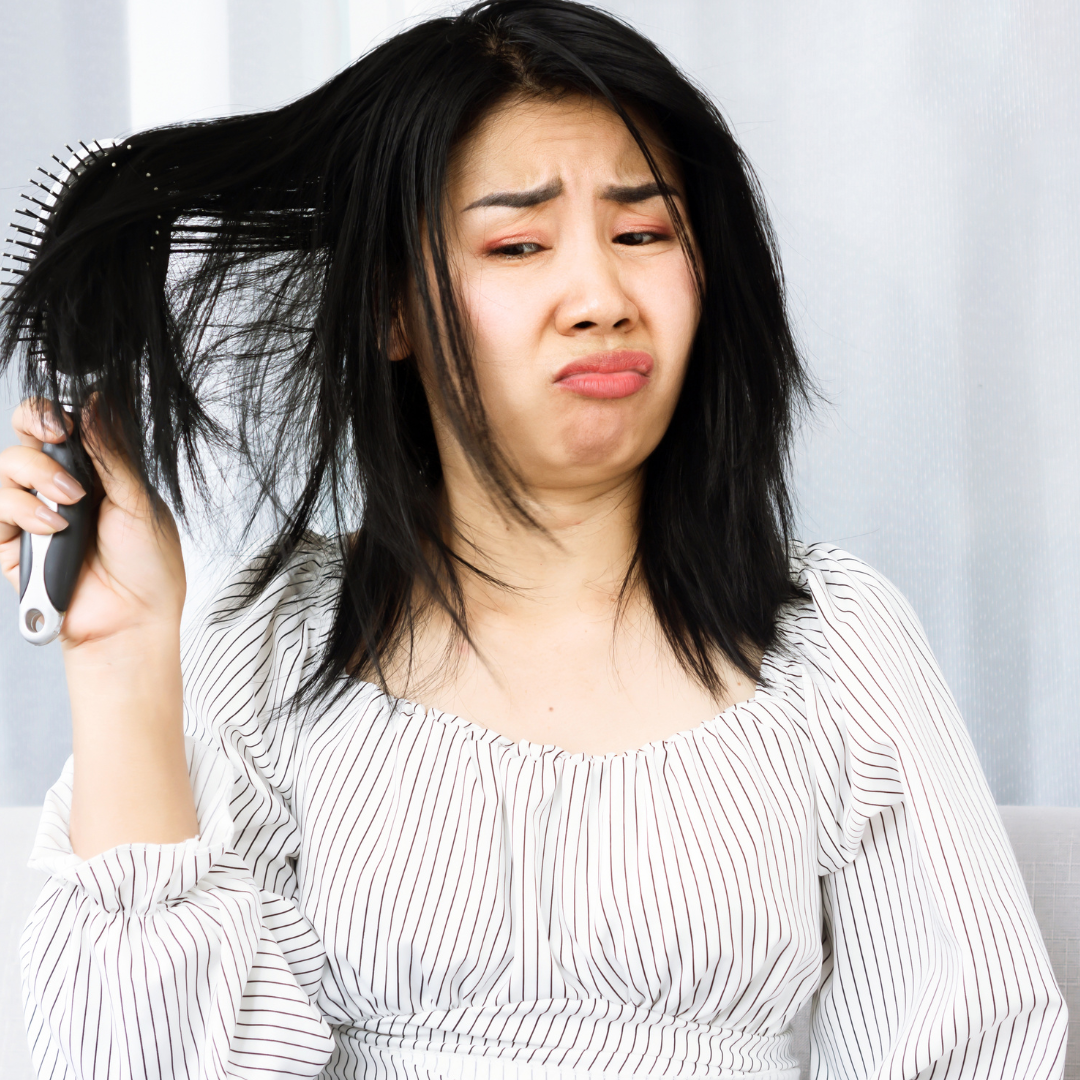
Most hair damage conversations start in the same place — heat tools, bleach, over-washing. And those things do matter. But the more interesting question is why hair that hasn't been chemically treated or heat-styled heavily still looks dull, feels brittle, and breaks more than it should. The answer is usually something people aren't thinking about at all.
What hair actually is — and why it's more vulnerable than it looks
Hair is not living tissue. Once a strand grows past the follicle, it has no ability to repair itself from the inside. Everything that happens to it from that point is cumulative and permanent — which means the way you treat your hair today is determining what it looks and feels like six months from now, when that strand is still on your head.
Each hair shaft is made up of three layers. The innermost is the cortex, which gives hair its strength and elasticity. Around it is the medulla. And on the outside is the cuticle — a series of overlapping scales, like roof tiles, that protect everything underneath. When those cuticle scales lie flat, hair looks smooth, reflects light well, and retains moisture. When they lift or crack, the hair becomes porous, loses moisture rapidly, and is vulnerable to physical breakage.
Almost everything people do to their hair — washing, drying, brushing, even tying it up — has some effect on the cuticle. The question is how much, and whether anything is being done to counteract it.
The humidity and pollution problem nobody talks about enough
In Singapore specifically, the combination of high humidity and urban pollution creates a particular kind of hair stress that's different from what people in drier climates experience. Humidity itself isn't damaging — in fact, moisture in the air can help hair retain hydration. The problem is that high humidity causes the hair shaft to swell as it absorbs water from the air, and then contract as it dries. Repeated cycles of swelling and contracting weaken the cuticle over time and contribute to frizz, not because the hair is dry, but because it's reacting to constant moisture fluctuation.
Pollution adds another layer. Fine particles and environmental residue settle on the hair and scalp, disrupting the microbiome, blocking follicles, and accelerating oxidative damage to the hair shaft. Washing more frequently seems like the solution, but over-washing strips the scalp's natural oils, which further disrupts the protective environment the follicle needs.
What scalp health has to do with hair quality
This is the part most people skip. The scalp is skin — and like facial skin, it has a microbiome of bacteria and fungi that exist in balance to keep it healthy. When that balance is disrupted — through harsh shampoos, product buildup, stress, or environmental factors — the scalp becomes either too oily, too dry, or inflamed. All three of those states affect the quality of hair that grows from it.
Probiotics applied topically to the scalp work similarly to how they function in skincare — they support the microbiome, reduce inflammation, and help maintain the conditions that allow the follicle to produce healthy hair. It's a relatively recent development in haircare formulation, and the evidence behind it is growing.
The gap in most people's hair routines
Shampoo and conditioner cover washing and immediate post-wash softening. Hair masks and oils add intensive treatment. But there's a gap in between — the hours after styling when hair is exposed to heat, friction, UV, and environmental stress without any active protection or nourishment.
This is where a leave-in treatment or hair mist earns its place. Not as a fragrance product, but as a functional step that delivers actives — niacinamide for scalp health and porosity, panthenol for moisture retention and elasticity, argan oil for cuticle smoothing — throughout the day rather than just in the shower.
Sukhatara's Osmanthus Patchouli Probiotics Essence Hair Mist does exactly this. The formula contains Sukhatara's proprietary stabilised probiotics alongside niacinamide, D-panthenol, and argan oil — ingredients that address scalp microbiome health, moisture retention, and cuticle protection in a single mist. The Osmanthus Patchouli scent is genuinely pleasant — warm, not overwhelming — but it's the functional layer underneath the fragrance that makes it worth the step. Singapore-made, paraben-free, phthalate-free. Available at Reverie on Hill.
Back to the routine
The most effective hair care isn't the most intensive — it's the most consistent. Protecting what you have between washes, keeping the scalp environment healthy, and minimising the cumulative stress on the cuticle produces better results over time than any single treatment product. Hair can't repair itself, but it can be maintained well enough that damage accumulates much more slowly.
That's the actual goal.