You've probably seen the phrase "salmon sperm serum" more times than you ever wanted to. It is doing the job marketing wants it to do — making you stop scrolling — and it is also, strictly, correct. The ingredient underneath is PDRN, polydeoxyribonucleotide, and the version used by most Korean brands really is extracted from the sperm of salmon trout (Oncorhynchus mykiss) or chum salmon (Oncorhynchus keta).
What the posts rarely mention is that nearly all the clinical evidence for PDRN comes from a needle, not a dropper. That is the part of the story worth understanding before you decide whether a $56 bottle belongs on your shelf.
What PDRN Actually Is
PDRN isn't one molecule. It's a population of DNA fragments, with individual pieces falling anywhere from roughly 50 to 1,500 kilodaltons according to the pharmacology literature cited by Dermatology Times' 2026 PDRN mythbusters piece. Inside the body, those fragments are thought to activate the adenosine A2A receptor and feed into DNA salvage pathways — essentially nudging cells toward building new tissue rather than inflammation.
The reason the injectable version (Rejuran being the most famous example) has traction is a small but real evidence base. A randomised split-face trial of 27 patients found that the PDRN side scored higher on the Global Aesthetic Improvement Scale at 16 weeks and showed greater skin-roughness improvement at 28 weeks than hyaluronic acid filler. There are also diabetic-foot-ulcer trials where injected PDRN roughly doubled the full-healing rate at eight weeks versus placebo. Different setting, same ingredient family, real randomised data.
That is the bedrock of the whole "PDRN is amazing" conversation online. It isn't about the serum.
How Topical PDRN Compares
Here is where it gets honest.
A big DNA fragment is a hard thing to push through intact stratum corneum. The usual rule of thumb in topical pharmacology is that molecules much above 500 daltons struggle to cross the skin barrier passively. Even a "low molecular weight" PDRN marketed at around 30 kilodaltons is still orders of magnitude larger than that. The chemistry blog Chemist Confessions summarised the situation plainly: the strongest topical PDRN human data is a 2004 skin-graft donor-site study, and even that was on open, healing skin — not intact faces.
That gap matters. Brands tend to show you an impressive-sounding supplier claim ("30% increase in fibroblast proliferation") and let you assume it will happen on your cheek. The ingredient did do something in a dish; a dish is not your face.
What the One Real Topical Study Actually Showed
The clearest published topical result as of late 2025 isn't salmon PDRN at all. It's a plant-derived version from the Chinese peony (Paeonia lactiflora), reported in the International Journal of Molecular Sciences in December 2025.
A quick, specific read of that paper:
| What they measured | What they found |
|---|---|
| Barrier recovery after SLS damage (n=10, 2 weeks, twice daily) | 21.0% drop in TEWL in the Low-Peony-PDRN arm vs 14.0% in control (p=0.026) |
| Periorbital elasticity, R2 parameter (4 weeks, twice daily) | 4.25% improvement vs baseline (p<0.001); between-group stats not reported |
| Sample size | 10 participants, mean age 41.6 |
| Who did the study | Six authors employed by NewLife BST, the company making the ingredient |
That is a genuine signal — the barrier result in particular is the kind of effect you'd expect from a humectant/nucleotide blend soothing freshly-irritated skin — and it is also a small, short, in-house study with no active comparator. Treat it as the start of an evidence base, not the finish of one. The authors say as much themselves in the limitations section.
For context: the two dermatologists bylined in the Dermatology Times review called that same peony study "the first published topical clinical evidence for any form of PDRN" and framed their overall verdict as "honest uncertainty rather than confident dismissal." That is a fair place to sit.
So Does the Serum Do Anything?
Probably — but likely not for the reason on the label.
Most PDRN essences and serums are formulated with the usual K-beauty supporting cast: hyaluronic acid, panthenol, glycerin, ceramides, allantoin, sometimes niacinamide. Those ingredients absolutely do things on intact skin. Softer, bouncier, better-hydrated skin after a few weeks of use is a real and useful outcome — it just isn't proof the PDRN itself crossed the barrier and rewired your fibroblasts.
If you already enjoy the texture and the ritual, that is a fine reason to keep using one. If you were buying it specifically because you'd read it does what injectable PDRN does, the evidence doesn't yet support that trade.
How to Read the Label Without Getting Spun
A few things worth looking for, if you want to buy with your eyes open:
- Source. Salmon-derived is still the clinical standard. Vegan versions from ginseng ("Phyto PDRN") or peony are newer; the only published topical trial so far is on peony. Different plant sources are not interchangeable.
- Concentration in ppm. Some Korean serums quote 100,000 ppm (10%) PDRN. A higher number doesn't mean more of it is reaching your dermis — delivery is the bottleneck, not concentration — but it does signal the brand is being specific rather than vague.
- The rest of the formula. Ceramides, panthenol and glycerin are doing real work in any good PDRN essence. If those are missing, the product is leaning entirely on an ingredient whose topical delivery isn't established. That's a shakier bet.
- "Microneedling in a bottle." This phrase has become shorthand for an unproven claim. The Dermatology Times reviewers specifically called it misleading. A serum is not a procedure.
The One PDRN Serum FYPIRL Carries
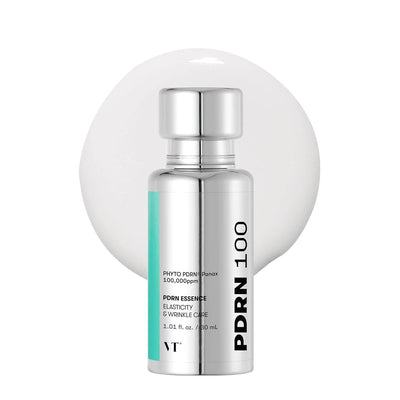
If you want to try the category, VT Cosmetics' PDRN Essence 100 is the one PDRN-labelled essence in our range right now. It uses the vegan, ginseng-derived "Phyto PDRN Panax" rather than salmon, and the formula includes ceramides, panthenol, squalane and allantoin — the hydrating, barrier-friendly supporting cast that explains why most PDRN essences feel nice to use.
Two honest caveats: the published topical PDRN trial so far is on peony-derived PDRN, not ginseng, so we can't transfer that result to this bottle. And stock is thin right now (one unit at time of writing) — if the page shows sold out when you click through, the trend will still be here next time it restocks.
If injectable-level results are what you actually want, the honest answer is still: ask a dermatologist about the injectable.
If a PDRN serum makes your skin feel better, that's real — but the credit almost certainly belongs to the hyaluronic acid, panthenol and ceramides sitting next to it, not the DNA fragments on the front of the box. For results anywhere close to what injectable PDRN delivers, you still need the injection.