There's a familiar hierarchy on skincare counters: retinol is the drugstore workhorse, tretinoin is the prescription everyone whispers about, and somewhere between them sits retinal — retinaldehyde — pitched as the "clinic-strength result without the clinic prescription." It's an attractive story. It's also one of those claims that sounds much tidier in a product description than it does in a journal.
Here's what's actually going on.
How a retinoid becomes something your skin can read
Vitamin A derivatives all work in the same way: they have to end up as retinoic acid inside skin cells before anything happens. Retinoic acid is the molecule that binds nuclear receptors, nudges fibroblasts to make more collagen, slows the enzymes that degrade it and speeds cell turnover (Scientific American's chemistry explainer walks through this cleanly).
The forms you buy over the counter sit upstream of that molecule:
| Form | Steps to retinoic acid |
|---|---|
| Retinyl esters (retinyl palmitate, etc.) | 3 |
| Retinol | 2 |
| Retinal (retinaldehyde) | 1 |
| Tretinoin (retinoic acid) | 0 — prescription |
So the "one step closer than retinol" claim is literally true at the enzymatic level. The question is how much that matters once a cream is sitting on skin.
What the trials actually show
Most of the data on retinal is small and recent. A 2021 split-face study on 23 Korean volunteers compared retinal and retinol at the same concentrations (0.05% and 0.1%) for eight weeks. Both sides improved on wrinkle depth and most objective measures; the retinal side edged ahead on several parameters but not on dermal density. That's genuinely interesting, but it's one small, single-centre trial — not a settled verdict.
Older vehicle-controlled data is more sobering. The NCBI review of retinoid aging trials notes a 44-week study of 0.05% retinaldehyde that found no statistically significant difference against vehicle on objective wrinkle measures. The paper is similarly tough on retinol: of nine vehicle-controlled retinol trials, four showed no significant difference from placebo, and the five that suggested a mild effect are flagged as methodologically shaky. Tretinoin, by contrast, has decades of trials behind it and remains the comparator everything else is judged against — and even in vitro, retinols are roughly 20× less potent than retinoic acid itself.
Independent chemists are blunter still. Chemist Confessions' write-up on retinal calls the evidence "early" and warns against bold "10× more effective than retinol" marketing lines — they aren't supported by the published studies.
Why retinal mostly disappeared, and why it's back
If retinal is theoretically closer to the active form, why hasn't it dominated the aisle for decades?
The answer is stability. Retinal degrades quickly — some stability studies on bare retinal only run 24 hours, which is nothing like a product's shelf life. Retinol is also finicky, but it's workable; retinal needed better delivery systems before it could sit in a serum for a year without turning into something less useful. Recent encapsulation technologies, including multilamellar vesicle systems developed in Korean labs, are the reason you're seeing credible retinal products on shelves now rather than just in dermatology clinics.
Short version: the chemistry has always been promising. The formulation is finally catching up.
Is retinal actually gentler than retinol?
This is the claim that gets the heaviest marketing push, and it's also where sources genuinely disagree. Some brand-published materials describe retinal as "same low irritation potential as retinol." A dermatologist quoted by Marie Claire expects more irritation from retinal, on the logic that something closer to retinoic acid is likely to behave more like it. The honest answer: there is no large, independent, apples-to-apples irritation trial that settles this.
Practically, that means two things. First, don't buy retinal expecting a free pass on the retinoid introduction period — the flaking, the pinkness, the "why does my face sting at my cheekbones" week. Second, don't rule it out if retinol has stopped doing anything visible; dermatologists do commonly use the step-up to retinal as a middle gear before considering prescription tretinoin.
How to actually use it
If you're starting a retinal, the sensible protocol looks a lot like starting any retinoid:
- Night only, on dry skin, two or three times a week to begin, working up as tolerated.
- A ceramide- or barrier-focused moisturiser afterwards — this is doing more work than any "sensitive skin" marketing claim.
- Sunscreen in the morning, every morning, non-negotiable. Retinoids thin the stratum corneum early on and photosensitise skin; you'll undo most of the benefit without SPF.
- Avoid stacking with strong exfoliating acids (AHAs/BHAs, high-dose vitamin C) in the same routine while your skin is still adjusting.
- Give it twelve weeks before judging. Collagen remodelling is slow; the 4-week "glow" people describe is mostly epidermal turnover.
Where retinal genuinely has a case
A few scenarios where reaching for retinal over retinol makes sense:
- You've been on an OTC retinol for 6–12 months and the visible returns have plateaued, but you're not ready to see a dermatologist for a prescription.
- You're treating periorbital concerns — fine lines around the eye, uneven tone — where the skin is thin, products need to be well-formulated, and small gains in receptor activation matter.
- You want a single evening active that nudges tone, texture and fine lines together, rather than layering three separate serums.
FYPIRL's pick
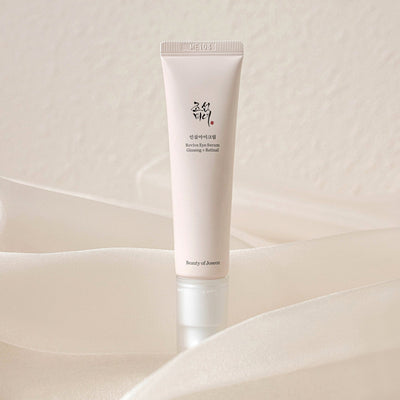
For a lower-stakes way to try retinaldehyde — on skin that's thin, visible and benefits from a well-formulated carrier — the Beauty of Joseon Revive Eye Serum: Ginseng + Retinal is a sensible place to look. It pairs retinal with ginseng extract and squalane as the vehicle, which keeps the texture light enough for the orbital area, and the dropper format makes it easy to control dose while you're still working out tolerance. It is specifically an eye serum, not a face-wide retinal treatment — don't treat it as a full-face retinal substitute if the goal is broader anti-aging.
Choose retinal because the formulation is good and the format fits your skin, not because of the "10× stronger than retinol" marketing — the published evidence doesn't go that far. Starting low, pairing it with a barrier moisturiser and non-negotiable morning SPF matters more than which retinoid you picked.