There's a quiet suspicion a lot of us carry around the shower: that "hair treatment" is basically conditioner with a bigger tube and a bigger price tag. It's a fair instinct — the marketing often blurs the two on purpose, and plenty of "masks" really are just thicker conditioners.
But the real distinction is less about branding and more about chemistry. Conditioners and treatments use overlapping ingredient families, in different concentrations, for different lengths of time on the hair. If you know what each one is actually trying to do, you can stop stacking them without reason and start getting the one that'll help you more.
What a conditioner is actually doing
A conditioner's job is almost entirely about the outside of the hair fibre. Clean, wet hair carries a slight negative charge, especially where the cuticle is roughed up by heat, bleach or friction. Conditioners deposit positively charged ingredients — cationic surfactants, cationic polymers, long-chain fatty alcohols — that are drawn to those negative spots and lay down a thin, lubricating film. According to a dermatology review of hair cosmetics in the International Journal of Trichology, this is what reduces static, cuts friction, improves "combability" and makes frizz behave (Dias, 2015).
A good conditioner is doing meaningful work. It just isn't trying to go deep into the hair. The whole point of a 60-second rinse is a surface effect: a smoother cuticle so the comb glides, light protection against the next round of friction, and a bit of silicone or oil to handle shine.
So what makes a "treatment" different?
A deep conditioner, hair mask or treatment — the names are mostly interchangeable in the aisle — is in the same family. The same review describes deep conditioners as "more concentrated or more viscous" versions of the rinse-off conditioner idea.
What that extra concentration buys you is twofold. First, more positively charged ingredients, which means more of them actually get to the damaged spots that need them. Second, treatments often lean harder on smaller molecules — low-molecular-weight hydrolysed proteins (keratin, wheat, collagen, silk) and smaller cationic polymers — that can diffuse past the cuticle into damaged parts of the fibre, where they can bind through ionic and other interactions. The same review is careful here: these don't rebuild keratin's structure the way a lot of packaging implies. They fill in, pair up with negatively charged damage sites, help seal lifted cuticle scales, and can reduce how much the fibre swells in water.
Longer contact time is the other half of it. A rinse-off conditioner has maybe a minute of wet contact. A mask or treatment is designed to sit for several minutes, which lets more of those ingredients actually find their binding sites instead of being hustled down the drain.
How often is "often enough"?
This is where the honest answer is boring: it depends on what your hair is doing.
Virgin, uncoloured, mostly-untreated hair doesn't have many damaged, negatively charged sites to speak of. A standard conditioner is usually enough, and piling on a weekly deep treatment can leave hair feeling heavy, limp or oddly "coated" rather than softer. The Trichology review notes that some conditioning polymers can build up on hair over time and even bind to anionic surfactants in a way that's harder to rinse out.
Hair that's bleached, highlighted, chemically straightened, heat-styled, or just long enough that the ends have been through years of weather and friction is a different story. That hair has more negative charge, more lifted cuticle, more places for a treatment's ingredients to grab onto. Here, once or twice a week usually earns its keep — most of the smoothness and manageability shows up in the days following the treatment, not just the hour after.
A reasonable rule of thumb: if your current conditioner already leaves your hair feeling the way you want, you probably don't need a treatment layered on top of it. If your lengths still feel rough, prone to tangles, or like they drink conditioner and ask for more, that's where swapping or adding a weekly mask is worth trying.
Conditioner vs treatment, at a glance
| Rinse-off conditioner | Hair mask / treatment | |
|---|---|---|
| Contact time | ~60 seconds | 3–10 minutes (per label) |
| Main job | Smooth cuticle, cut friction, aid combing | More deposition on damaged sites, longer-lasting softness |
| Where it works | Mostly on the cuticle surface | Surface + some diffusion into damaged areas |
| How often | Every wash | Weekly, or 1–2x a week on damaged/long hair |
| Where to apply | Mid-lengths to ends | Mid-lengths to ends |
Where products like Grafen fit
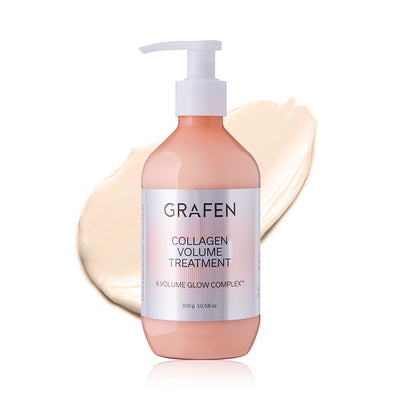
If you're looking for a treatment to try on dry or limp lengths, Grafen's Collagen Volume Treatment is a reasonable example of the format: a thicker rinse-off mask with collagen, hyaluronic acid, centella and camellia, built to sit on wet hair for one to three minutes after shampooing before you rinse. It's a weekly-ish step rather than a daily one — the whole point of a treatment is that you give it more time and don't need it every single wash.
Collagen in a hair product, worth noting, is not restructuring your hair from the inside out. Hydrolysed collagen is a protein fragment that behaves like other small hydrolysed proteins: it can adsorb to the fibre and may lightly fill in damaged areas, which can make the hair feel smoother and look fuller. That's a real effect, but it's a surface and near-surface one. No topical treatment grows new keratin.
The one honest trade-off
The thing most people get wrong isn't choosing the "wrong" product — it's over-applying the right one. More protein isn't better; past a point it can leave hair feeling stiff. More conditioner isn't better; past a point it coats and weighs hair down. A weekly deep treatment on the lengths, a standard conditioner the rest of the time, and both kept well away from the scalp, will do more for most people than an elaborate daily stack.
If this is useful, our guide to pre-wash hair oiling covers a different, complementary step — one that happens before shampoo, and does something a rinse-off conditioner genuinely can't.
Use a conditioner every wash on your lengths; use a treatment weekly if your ends actually need it. Stacking both on every shower day is where most of the "my hair just feels coated" complaints quietly come from.