Open almost any K-beauty routine from the last three years and "cica" seems to float through every step — in the toner, the ampoule, the sheet mask, even the sunscreen. The green leaf has become so ambient it's easy to assume there's nothing much behind it. That read undersells it. The marketing really is everywhere, but the plant underneath has a surprisingly long paper trail — enough that European pharmacies have carried a titrated Centella extract called TECA for decades, mostly for wound healing, scars and vein problems.
Here's the useful version of that paper trail, and the point at which it stops being evidence and starts being vibes.
What Centella asiatica actually is
Centella asiatica is a small creeping herb that grows across South and Southeast Asia — Singapore included, where you'll see it in traditional kitchens as pegaga. In skincare labels it shows up three ways: as the extract (Centella Asiatica Extract or Leaf Extract), as isolated active compounds, or under the shorthand "cica" (from cicatrisant, French for scar-healing).
What's doing the work isn't the leaf itself, it's four related compounds called triterpenes: asiaticoside, madecassoside, asiatic acid and madecassic acid. Together they're sometimes called "madecassosides" on an ingredient list, and in European pharmacy formulas you'll see them titrated to a known percentage so each tube is reproducible. That matters, because a cream listing centella at the very bottom of the ingredients deck is doing something quite different from one listing all four compounds by name.
The four compounds doing the work
The useful mechanisms, pulled from a 2021 review in Evidence-Based Complementary and Alternative Medicine that collates the lab and animal evidence:
| Compound | What it appears to do |
|---|---|
| Asiaticoside | Boosts collagen type I and III synthesis via the TGF-β/Smad pathway in fibroblast and burn models |
| Madecassoside | Dampens inflammatory signalling — lower TNF-α, IL-1β, IL-6 in irritated-skin models |
| Asiatic acid | Antioxidant activity; involved in collagen deposition in healing wounds |
| Madecassic acid | Supports the broader anti-inflammatory profile; often listed alongside the others |
Most of this is preclinical — cell cultures, animal wounds, phthalic anhydride-induced skin inflammation models. That's enough to say how cica probably works, but not enough on its own to say how well it works on an intact human face at the concentrations in a serum.
What the clinical trials actually show
A 2022 systematic review in the International Journal of Environmental Research and Public Health pulled together the human evidence. Four randomised trials met inclusion criteria, 273 participants in total. Small, but worth knowing what they found:
- Burns (Saeidinia et al.): topical centella shortened healing time to about 14.7 days versus 21.5 days for standard silver sulfadiazine, with lower pain scores and faster re-epithelialisation.
- Diabetic wounds (Paocharoen): oral centella improved wound contraction and granulation versus control.
- Post-laser facial wounds (Damkerngsuntorn et al.): less erythema and better wound appearance after fractional laser treatment — the one that maps most cleanly to what someone with "angry skin after a treatment" is actually using cica for.
- Chronic anal fissure (Chiaretti et al.): bleeding and pain improved, though not all differences reached statistical significance.
The reviewers were honest about the limits: four trials, mixed designs, no meta-analysis possible, some risk of bias. They concluded centella may improve healing — through better angiogenesis and anti-inflammatory signalling — and that more work is needed. That's a long way from "proven barrier repair in a bottle". It's also meaningfully more than most ingredients on your shelf can show.
Where cica genuinely helps — and where it doesn't
The pattern across the preclinical and clinical work is consistent: cica is a calming ingredient. It's at its best when there's inflammation to turn down — post-procedure redness, a reactive flare after over-exfoliating, visible flushing, slow-healing spots. The Korean habit of layering a centella toner the day after a bad reaction is doing something coherent with the evidence.
What cica is not reliably doing, on current evidence:
- Rebuilding a damaged skin barrier on its own. The 2021 review explicitly didn't find direct barrier-function effects. If your skin is stinging under every product, ceramides, cholesterol, fatty acids and humectants are still the backbone — cica is a sensible companion, not a replacement.
- Clearing active acne. The lab work shows anti-inflammatory activity on acne-adjacent pathways, but crude extracts had little antibacterial effect on C. acnes. It can calm the redness around a spot; it is not a benzoyl peroxide stand-in.
- Fading established scars. The "cica" shorthand comes from scar-healing roots, but the clinical trials sit mostly in fresh wound healing, not months-old marks.
How to use it without doubling up
Cica plays well with almost everything — niacinamide, hyaluronic acid, panthenol, ceramides, sunscreen. It layers quietly under actives like retinoids, which is why "retinol + cica" has become a predictable K-beauty pairing for reactive skin.
A few practical calls:
1. If you only buy one cica product, make it a cream or a serum with the four compounds listed by name, not just "Centella Asiatica Extract" at the end of the deck. A product that bothers to spell out asiaticoside, madecassoside and the two acids is usually a better-formulated one.
2. One cica step is enough. Stacking a cica toner, cica serum, cica cream and cica sunscreen doesn't give you four times the effect — it mostly dilutes everything else your routine was trying to do.
3. Introduce it on calm skin first. Botanical extracts can still irritate; the "centella allergy" is real for a small subset of users. Patch-test on the jaw for a couple of nights.
4. For post-procedure or post-sunburn skin, keep it simple. Gentle cleanser, cica cream, sunscreen. Save the acids for next week.
FYPIRL's picks
Two centella-forward formulas on the FYPIRL shelf that match what the evidence actually supports.
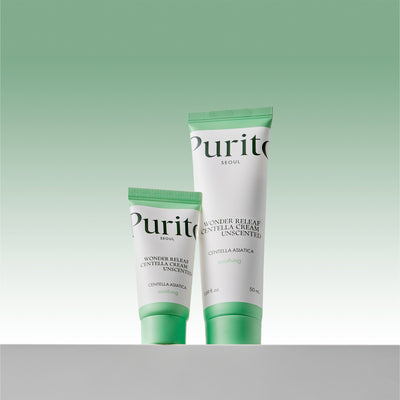
PURITO SEOUL Wonder Releaf Centella Cream Unscented lists Centella Asiatica Extract at 29,891 ppm — about 3% of the formula — alongside asiaticoside, madecassic acid and asiatic acid. Unscented and fragrance-free, which matters when the whole point is to stop irritating skin. A reasonable daily cream for reactive, redness-prone or post-active skin.
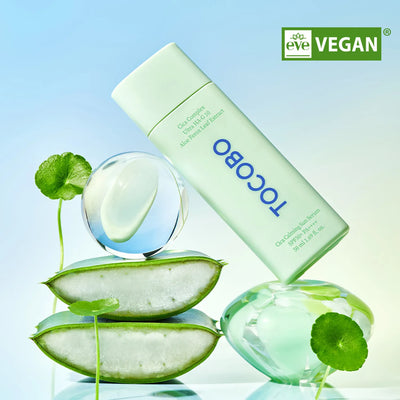
TOCOBO Cica Calming Sun Serum SPF50+ PA++++ pairs the same four compounds (asiaticoside, madecassoside, asiatic acid, madecassic acid) with a lightweight, serum-feel chemical SPF. UV exposure is itself an inflammatory event, so sunscreen is the single most useful "anti-redness" step most people aren't fully doing — a cica-forward SPF is a quiet way to fix that without a separate soothing step.
Keep what the rest of your routine is for. Hydration still comes from humectants and emollients. Pigment work still comes from your actives. Cica is the layer that lets everything else land on skin that isn't currently in flames.
Treat cica as a calming layer, not a cure-all — one well-formulated cica cream or SPF on reactive or post-procedure skin earns its place; four cica products stacked on each other mostly cancel out the rest of your routine.