Hair oil has a bit of a branding problem. In a glossy campaign it shows up at the end — a few drops smoothed through dry ends for shine, usually by someone whose hair didn't need any help in the first place. That's a fine styling move. It's just not the version of hair oil with the actual research behind it.
The stronger evidence sits in the step most people skip: putting oil in your hair before you wash it, letting it sit, and then shampooing it out.
Why water is the real problem hair oil solves
Hair is strongest when it's dry. The moment it gets soaked, the fibre swells, the cuticle scales lift, and anything you do while it's in that state — rubbing with a towel, combing, piling it on top of your head — chips bits of cuticle off. Do that two or three times a week for a decade and you have what the trade calls hygral fatigue: the slow, cumulative stripping that turns a healthy shaft into one that frays at the ends and snaps halfway up.
The useful question is whether anything applied before the water hits can reduce that swelling. The 2003 study everyone in hair science keeps citing is the one that tried to answer this directly.
What the coconut oil study actually found
Aarti Rele and R. B. Mohile, working out of Marico's R&D lab in Mumbai, compared three oils that are commonly sold as hair oil: mineral oil, sunflower oil and coconut oil. They applied them before and after washing, on both undamaged and chemically damaged hair, and measured the protein lost through the wash.
Their finding was blunt. "Among three oils, coconut oil was the only oil found to reduce the protein loss remarkably for both undamaged and damaged hair." Mineral and sunflower oils, in their words, "do not help at all in reducing the protein loss from hair." (Journal of Cosmetic Science vol. 54)
The authors' explanation is a chemistry argument. Coconut oil is mostly lauric acid — a small, straight-chain fatty acid with a genuine affinity for keratin. It can slip into the cortex. Mineral oil is a hydrocarbon that doesn't bond with hair protein, so it sits on the surface. Sunflower oil has the kinks (unsaturated double bonds) that make its molecules too bulky to push into the fibre. Only one of them actually gets inside the shaft before you turn the tap on — and once it's in, there's less room for water to swell the fibre in the first place.
A couple of honest caveats: the lead researcher worked for a company that sells coconut-oil hair products, and the whole thing was lab-measured on hair tresses rather than on a human head counting split ends. But the mechanism — small molecule, protein affinity, less swelling — is biologically consistent with everything else known about hair. And it's one of the few hair claims that doesn't get softer the harder you look at it.
Not every "hair oil" is doing the same thing
This is where the shelf gets confusing. Walk into any beauty aisle and three different bottles will all say "hair oil" on the front while doing three different jobs.
| What's in the bottle | Where it works | What it's actually for |
|---|---|---|
| Virgin coconut oil | Penetrates the cortex | Pre-wash protection against protein loss |
| Argan, almond, jojoba, olive | Partial penetration + surface film | Softening, moderate pre-wash use |
| Mineral oil, silicones (dimethicone, dimethiconol), C13–C19 alkanes | Surface film only | Shine, slip, frizz control, finishing step on dry hair |
A silicone-based finishing oil like Yann Beyrie Ambre — whose formula is dimethicone, dimethiconol and a light alkane — is a lovely leave-in for taming humidity frizz on dry ends. It is not a pre-wash penetrating oil, and it won't do what coconut oil did in the Rele study. Both are legitimate products. They just belong at different ends of the wash.
If you're buying something specifically for a weekly pre-shampoo treatment, the supermarket bottle of plain virgin coconut oil is both the cheapest and the most studied option. You don't need a luxury version.
How to actually do a pre-wash oiling
Fast version: oil, wait, wash. A slightly longer version:
- Start with dry hair. Wet hair is already swollen, which is exactly the state you're trying to prevent. Oil applied to dry hair works into the cuticle properly.
- Focus on the lengths and ends, not the roots. If your scalp runs oily, keep the oil below the ear line. If it runs dry or you have a flaky scalp, a short gentle massage into the scalp is fine, but it won't regrow hair, so don't expect that.
- Give it time. The lab studies used both pre- and post-wash application. In real life, 30 minutes is a useful minimum; overnight on a towel-covered pillow is traditional in a lot of South and Southeast Asian households for a reason. Longer isn't dramatically better after a certain point.
- Shampoo it out properly. This is the step that trips people up. Apply shampoo directly to the oily hair before water — the surfactants bind to the oil and emulsify it. Then rinse. If you add water first, the oil beads up and the shampoo can't get to it, and you end up washing three times.
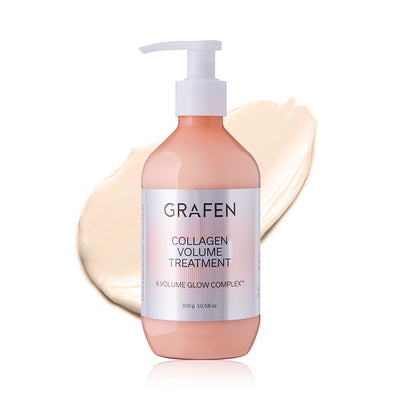
- Follow with a conditioning rinse. Oiling softens the cuticle; a rinse-out conditioner smooths it down again before you dry. A protein-and-moisture formula like Grafen Collagen Volume Treatment — collagen, hyaluronic acid and a touch of argan — is a reasonable follow-up because it adds slip back without weighing fine hair down after the oil's gone.
Once a week is enough for most hair. Twice a week is reasonable if your hair is coarse, chemically treated or living under daily heat styling. Daily is overkill and will make your shampoo work harder than it needs to.
Does this change in Singapore humidity?
A little, in both directions. The humidity means hair stays slightly damp for longer after a wash, which is exactly the swollen state that drives hygral fatigue — so an occasional pre-wash oil is arguably more useful here, not less. On the other hand, coconut oil is solid below about 24°C and liquid above it; in an air-conditioned flat the jar might cloud up and need a few seconds of warming between your palms before it spreads. Not a problem, just a quirk of the ingredient.
A pre-wash oiling is not going to fix bleach damage, stop shedding or thicken a fine ponytail. What it does, slowly and quietly, is reduce the amount of cuticle you're grinding off every time you wash. Over months, that's the difference between ends that fray by the time they reach your collarbones and ends that don't.
One pre-shampoo oil application a week, left on for at least half an hour, is a small habit with better cuticle-protection evidence behind it than most of the "repair" claims printed on shampoo bottles. Don't overthink the oil — virgin coconut from the supermarket is the one that was actually in the study.