You know the feeling. A tingle where your toner used to just sit. Your usual moisturiser now stings around the nostrils. Weather that never bothered you suddenly leaves a red patch across the cheeks. Skincare that felt fine a month ago is now doing something new — and the instinct, almost every time, is to reach for another soothing serum.
That instinct is worth resisting. Skin-barrier repair is one of the few areas of skincare where the honest answer is closer to do less. The people who bounce back fastest are almost never the ones who added a cica ampoule on top of everything else — they're the ones who quietly deleted three steps and let the skin get boring again.
What "barrier damage" actually is
The outermost layer of your skin — the stratum corneum — is a brick-and-mortar wall. The bricks are dead keratinocytes; the mortar is a mixture of ceramides, cholesterol and free fatty acids. Their approximate molecular ratio is 1:1:1, but that does not mean equal percentages by weight: ceramides account for about half of the matrix's weight. Long-chain ceramides are particularly important to its water barrier.
When you see elevated transepidermal water loss (TEWL) — the measurement dermatology researchers use as shorthand for "how leaky is this skin right now" — what's happened underneath is a shift in that lipid composition. A 2024 review in the Journal of Lipid Research summarised it bluntly: in skin conditions from atopic dermatitis to psoriasis, you consistently see "an increase in short-chain and a decrease in long-chain ceramides", plus a self-reinforcing loop where a leakier barrier triggers inflammatory cytokines, which then further suppress the enzymes that build ceramides in the first place. Barrier damage is a cycle, not an event.
The practical takeaway isn't dramatic: it's that things that erode long-chain lipids (over-cleansing, over-exfoliating, alcohol-heavy toners, layering three actives on top of each other) drive the cycle, and things that hand the skin back its raw materials — ceramides, cholesterol, fatty acids, humectants — help interrupt it.
The short, boring routine
Four steps. That's it. Add nothing else for two to four weeks.
1. A gentle, non-foaming cleanser, once a day. Wash at night. Rinse with lukewarm water in the morning. Foaming surfactants aren't evil, but a compromised barrier is more permeable to them, which is part of why previously-fine cleansers suddenly sting. If your face feels tight or squeaky after washing, the cleanser is too strong for right now.
2. A humectant layer on damp skin. Panthenol (provitamin B5), glycerin and hyaluronic acid all pull water into the outer layers. Damp application matters — a humectant applied to bone-dry skin in a dry room will pull moisture out of deeper layers instead of holding it in.
A 2025 double-blind RCT in the Journal of Cosmetic Dermatology gives a useful example of a barrier-supporting formula. Sixty people used either a panthenol-enriched mask or saline dressings after non-ablative laser treatment. At day 14, average TEWL was 11.49 in the mask group versus 16.11 in controls; measured hydration was 51.55% versus 44.76%. The mask also contained madecassoside and bisabolol, and both groups used a panthenol-containing balm. The benefit belongs to that tested regimen, not panthenol alone; the mask's occlusion may also have contributed. It's an encouraging post-laser result, not a direct trial of everyday irritated skin.
3. A ceramide-rich moisturiser, morning and night. Look for a product that lists Ceramide NP, Ceramide AP and Ceramide EOP (or a "Ceramide Complex"), ideally in the same jar as cholesterol and a fatty acid like linoleic or stearic acid. The combination matters, not simply the number of ceramides on the label. The 2024 review describes native barrier lipids in an approximately 1:1:1 molecular ratio; that is a description of skin, not a requirement that every moisturiser use one fixed formula.
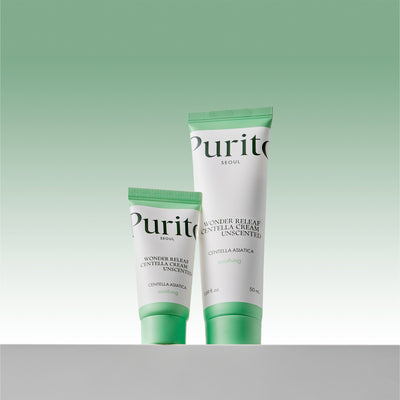
A useful example on FYPIRL's shelf right now is PURITO SEOUL's Wonder Releaf Centella Cream Unscented ($27, 50ml). It pairs a very high concentration of centella asiatica extract (29,891 ppm — about 3%) with Ceramide NP, squalane and niacinamide, and it's unscented, which matters more than most fragrance-defenders like to admit for reactive skin. It's a cream that behaves like a routine on its own for a couple of weeks.
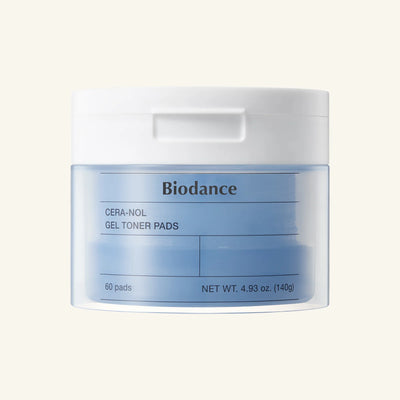
For a slightly more soothing daily step, BIODANCE's Cera-nol Gel Toner Pads ($34) combine ceramides, allantoin, hyaluronic acid and panthenol in a swipe-on format — useful for the humectant step above without adding a new bottle to the shelf.
4. A mineral sunscreen. Yes, even indoors near a window. UV disrupts barrier repair. During a reset, most people tolerate zinc oxide or titanium dioxide better than chemical filters. If your usual SPF is stinging, it's not necessarily the SPF — it's often the actives underneath doing damage first.
That's the whole routine. No vitamin C. No retinoid. No acid toner. No niacinamide serum stacked on top of a niacinamide moisturiser. Nothing "brightening", nothing "resurfacing", nothing that markets itself with the word powerful.
How long before you'll know it's working
Two to four weeks of dull consistency is the honest answer. The ceramide review in PMC describes barrier repair as a feedback loop — meaning improvements compound, but slowly, because the same inflammatory cytokines that drive damage also suppress the enzymes that make new lipids. The loop takes time to reverse in either direction.
Some rough signposts:
| Time in | What you'd expect if it's working |
|---|---|
| Days 1–3 | Stinging stops within seconds of application, not minutes |
| Week 1 | Baseline tightness eases; makeup sits better |
| Weeks 2–3 | Redness across cheeks and nose reduces at rest |
| Week 4 | You can cautiously reintroduce one active, on alternate nights, and see how it goes |
If you're at week four and nothing has improved, that's the point to see a doctor. Persistent stinging, scale, oozing or a defined rash pattern isn't "just a compromised barrier" — it may be perioral dermatitis, contact dermatitis, seborrhoeic dermatitis or rosacea, and each has its own treatment. A short routine won't fix a diagnosis it can't reach.
What to reintroduce first (and how)
When you do start adding back, the order that irritates the fewest people is roughly: niacinamide → azelaic acid → retinoid → AHA/BHA → vitamin C. Introduce one at a time. Alternate nights for two weeks before layering. If a product stings for more than a few seconds on skin that's been calm for a month, that's information — believe it and back off.
The unglamorous truth is that most "reactive skin" isn't a permanent skin type. It's a barrier that was pushed too hard, too long, by a routine that made sense on paper. Giving it a few boring weeks tends to return more skincare freedom, not less.
Barrier repair is one of the few areas of skincare where doing less genuinely outperforms doing more — a boring four-step routine held for a month usually beats a shelf of soothing serums used inconsistently.